
The most common thing I hear in a first conversation with someone married to the person who ran the money is a version of this: I don't actually know what we have.
Colorado's answer to that is unusually strong, and most people going through a divorce here have no idea it exists.
Disclosure is affirmative, not responsive
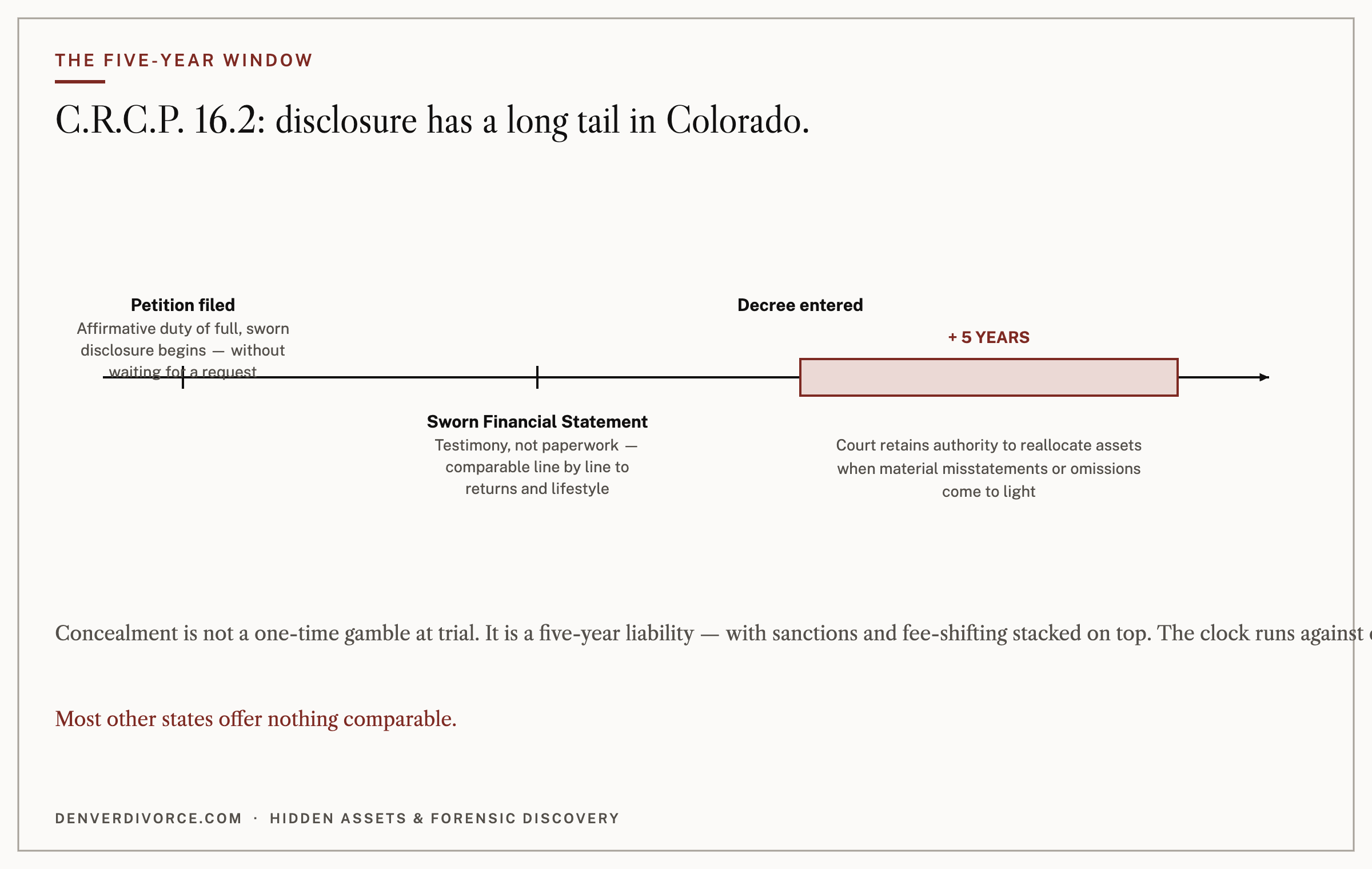
Under Colorado Rule of Civil Procedure 16.2, both parties owe an affirmative duty of full and honest disclosure of all material assets, liabilities, income, and expenses. Sworn. Required without waiting for anyone to ask.
That is a meaningfully different regime from the one most people expect. The ordinary intuition about litigation is that you get what you ask for, and that a clever opponent gets to keep whatever you failed to think of. Rule 16.2 flips that. Your spouse's obligation to reveal exists from the beginning of the case, independent of your discovery requests, and the gaps in what they produce are themselves evidence.
The Sworn Financial Statement is not paperwork. It is testimony, and it is testimony that can be compared line by line against tax returns, bank records, and lifestyle.
The five-year tail
Here is the part that changes behavior.
Rule 16.2 gives the court continuing authority for five years after entry of the decree to reallocate assets and liabilities when material misstatements or omissions in a party's disclosures come to light. Most states offer nothing comparable.
In Colorado, concealment is not a one-time gamble at trial. It is a five-year liability. Combined with fee-shifting and sanctions exposure, that materially changes the calculation for anyone contemplating it — and it is worth saying plainly that the clock runs against everyone's disclosures, including my own clients'.
Where value actually hides
Concealment in a sophisticated estate is rarely dramatic. It is almost never cash in a safe. It is timing and characterization:
- Income deferred until after the decree — a bonus that slips a quarter, a contract that signs in January.
- Receivables slowed, or a sudden and well-argued need to reinvest everything in the business.
- Loans to a related entity that never quite come back.
- Personal expenses run through the company.
- New accounts at institutions the other spouse has never heard of.
- Transfers to family members, structured as gifts or repayments.
- Digital assets moved off exchanges, where custody leaves no statement.
Each of these is a lever someone who runs a business already knows how to pull, because they installed it for legitimate reasons years earlier.
The method
Systematic, and mostly unglamorous.
Subpoenas to banks, brokerages, and exchanges — the records that exist independent of what anyone swore to.
Tax returns read line by line against the sworn statements. Schedule B interest implies a principal balance. Schedule E implies property. A K-1 implies an entity. Every line is a thread, and the discrepancy between the return and the disclosure is the whole case.
Lifestyle analysis. When a household consumes more than it reports earning, the difference came from somewhere. This is frequently the most persuasive exhibit in the file, because it requires no expert to understand.
Forensic accountants engaged early, not summoned in the last month before trial when there is no time left to follow what they find.
If you are the spouse who doesn't know
Three things, starting today.
Gather what you already have access to — tax returns, statements, loan applications. A loan application is a sworn statement of assets made when someone wanted to look wealthy, and it frequently contradicts a divorce disclosure made when they want to look otherwise.
Write down what you remember: accounts you have seen, institutions mentioned, purchases that were never explained. Memory degrades and the list is worth more now than in six months.
Do not confront. A spouse who learns you are looking has time to prepare. The process works better when the records arrive before the explanation does.
Related on DenverDivorce.com: Hidden Assets & Forensic Discovery · Complex Financial Divorce
