
Three kinds of property start out as yours alone in Colorado: what you owned before the marriage, what you inherited, and what was given to you as a gift.
That is where most people's understanding stops, and it is why most separate-property claims are in trouble long before anyone files anything.
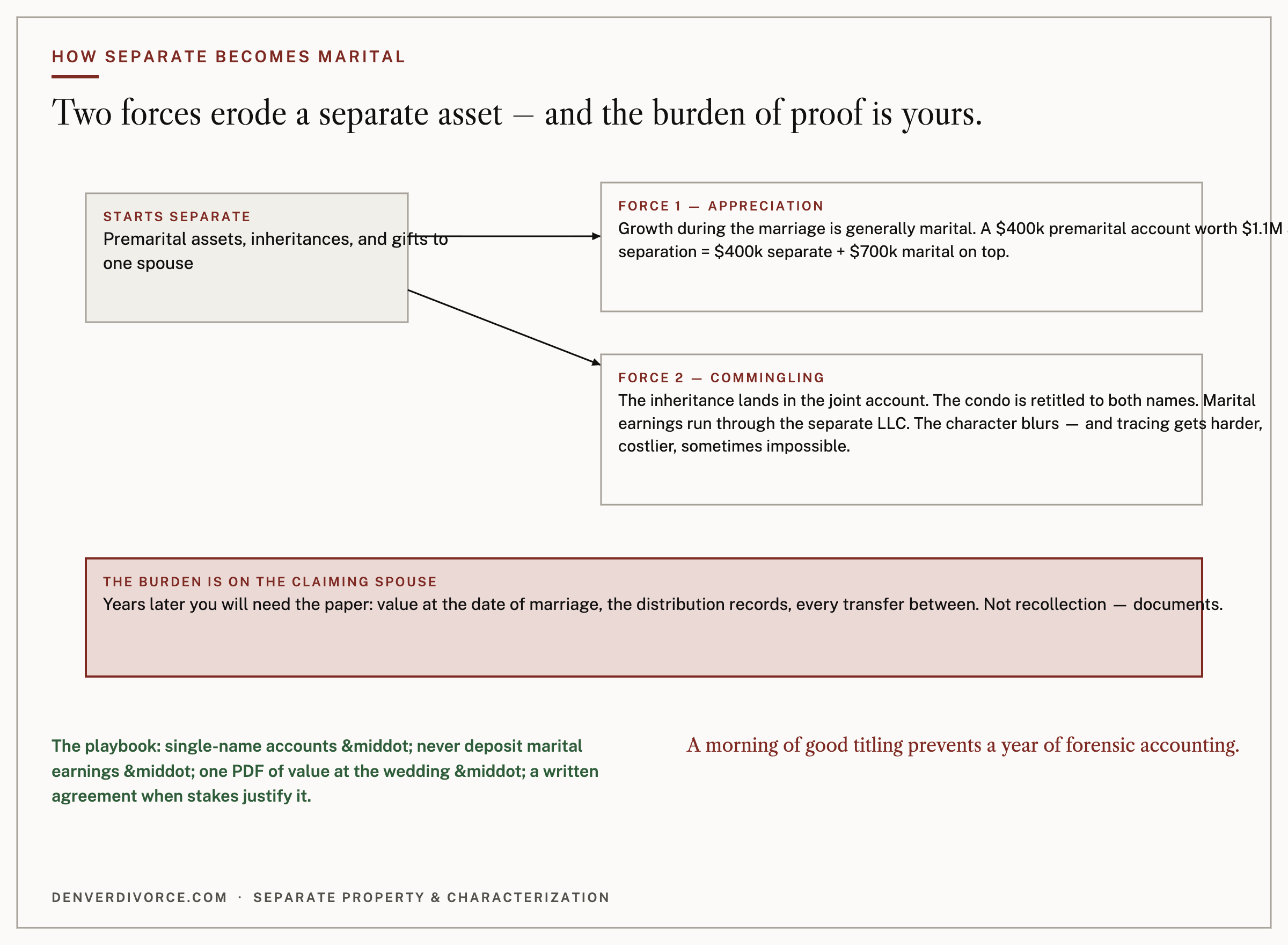
Two forces erode it
Appreciation. Colorado treats the increase in a separate asset's value during the marriage as marital. The underlying asset can remain yours if you can prove and trace it — but its growth since the wedding is on the table. A premarital brokerage account worth $400,000 at the wedding and $1.1 million at separation is not a $1.1 million separate asset. It is a $400,000 separate asset with $700,000 of marital appreciation sitting on top of it, and the second number is usually the one worth fighting about.
Commingling. Deposit the inheritance into the joint account. Retitle the condo into both names. Run marital earnings through the separate LLC. Each of these blurs the character of the asset. Not always fatally — but the tracing gets harder, more expensive, and sometimes impossible.
Neither of these is a punishment. They are the predictable consequence of running a shared life through shared accounts, which is what married people do.
The burden is yours
This is the part that surprises people. The spouse claiming an asset is separate bears the burden of proving it.
Which means that years later, you will need the paper: statements showing the balance as of the date of marriage, the inheritance distribution records, and every transfer in between. Not your recollection of it. The documents.
I build tracing files the way I build trial exhibits, because that is exactly what they become — a chain from origin to present balance, each link supported by a record produced by someone other than my client.
Where that chain is complete, separate-property claims hold up well. Where there is a gap of two years in the middle because an old bank stopped providing statements, the claim is worth whatever the rest of the record can carry.
The playbook nobody follows
For anyone still married — or about to be — the preventive version of this is almost embarrassingly simple:
- Keep separate assets in separate, single-name accounts.
- Never deposit marital earnings into them. Not once, not for convenience.
- Keep a contemporaneous record of value at the date of marriage. One PDF, filed somewhere you will find it in fifteen years.
- Where the stakes justify it, put the characterization in writing through a prenuptial or postnuptial agreement — which remains the only genuinely reliable way to keep future appreciation separate.
A morning of good titling prevents a year of forensic accounting. That is not a figure of speech; the accounting bills in a contested tracing dispute regularly exceed what the disputed appreciation is worth.
Three questions I hear constantly
"Is my inheritance safe if we divorce?"
If it stayed in your name, untouched by marital funds, and you can document it — generally yes, though its growth during the marriage is marital. If it went into the joint account, the answer now lives in the records rather than in the law.
"We used my premarital savings for the house down payment. Do I get it back?"
Possibly. A contribution of separate funds to a marital asset can be recognized in the division, but it must be traced and it is not automatic. This is one of the most commonly litigated patterns in Colorado divorce, and the quality of the documentation usually decides it.
"Can we just agree on what's separate?"
Yes — in writing, properly executed, with real disclosure on both sides. That is what a marital agreement is for, and it is dramatically cheaper than proving the same thing later.
If you are already in it
Do not reconstruct. Do not create a summary spreadsheet and present it as the record — a spreadsheet built after the dispute began is an argument, not evidence, and it invites exactly the wrong kind of cross-examination.
Collect what exists. Bring the gaps as gaps. The paper decides, and a candid account of what the paper shows is a far stronger position than a tidy narrative that does not survive a subpoena.
Related on DenverDivorce.com: Separate Property · Property Division · Prenuptial Agreements
