
Colorado is one of the few states that still recognizes marriage without a license or a ceremony. Which means that in some cases, the first fight isn't how to divide the estate — it's whether a marital estate exists at all.
Why the question is worth everything
If a common law marriage exists, everything acquired during it is presumptively on the table: the business, the appreciation, maintenance, the entire architecture of divorce law. If it doesn't, the parties are legally strangers, and property follows title. No other single question in family law swings outcomes this completely — which is why these cases are litigated with the intensity of the fortunes riding on them.
The modern test
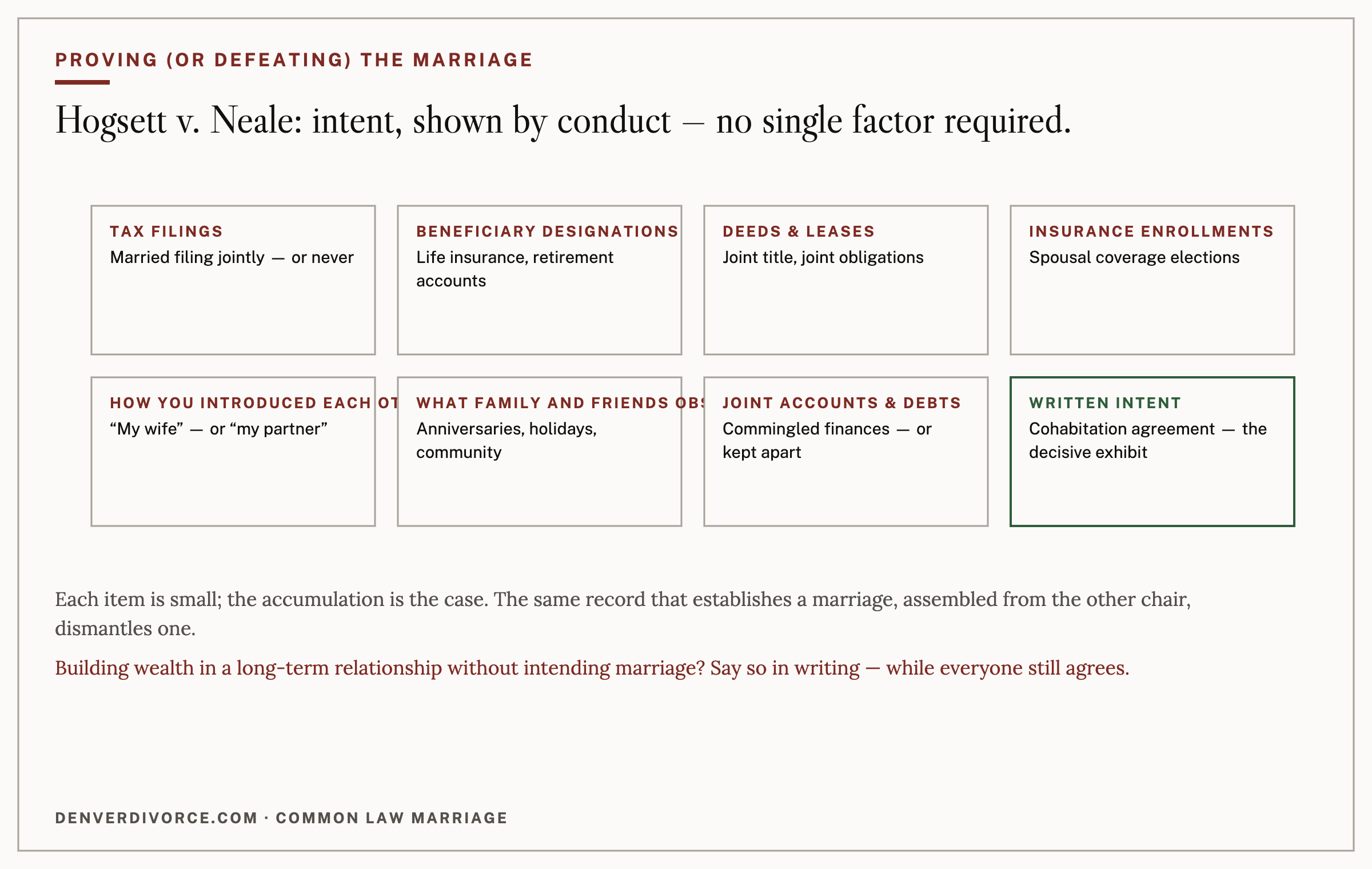
In Hogsett v. Neale (Colo. 2021), the Colorado Supreme Court refined the inquiry: a common law marriage exists when the parties mutually agreed to enter a marital relationship and their conduct manifested that agreement. The old checklist — cohabitation, joint accounts, shared last names — still matters as evidence, but no single factor is required. The question centers on the couple's intent in the context of their actual lives, and the same decisions confirmed the doctrine applies equally to same-sex couples, including for years before marriage equality.
That reframing cuts both ways. A couple who checked few traditional boxes can still be married if their conduct shows the agreement. A couple who shared a house and a checking account for a decade may not be, if the evidence shows they deliberately chose not to marry.
What the evidence looks like
These cases are won with the record of ordinary life: beneficiary designations, insurance enrollments, tax filing status, deeds and leases, how the couple introduced each other, what family and friends observed, anniversary cards, joint obligations. Each item is small; the accumulation is the case. I build — or dismantle — that record the way I build a valuation fight: document by document, witness by witness.
I take these cases from either chair. Sometimes my client needs to establish the marriage — years of partnership and a shared enterprise, met with a claim that they were merely roommates. Sometimes my client needs to defeat a relationship being retroactively upgraded to marriage precisely because a business became valuable. The analysis is identical; only the advocacy points in different directions.
For the unmarried and successful: clarity is cheap
If you are building wealth inside a long-term relationship and do not intend marriage, say so in writing. A cohabitation agreement — the unmarried sibling of the prenup — documents intent while everyone still agrees on it, which is exactly when documentation is possible. It costs a fraction of one month of the litigation it prevents.
Related on DenverDivorce.com: Common Law Marriage · Property Division · Prenuptial Agreements
