
In most business-valuation fights, everyone shows up ready to argue about a percentage: should a discount for lack of marketability apply, and how large? Thirty percent? Fifteen? Zero?
That is the question everyone expects. It is rarely the question that decides the case. The real fight is one level up: what are we valuing, and for whom? Colorado does not statutorily define the standard of value for business interests in divorce — courts have broad discretion — and the standard the court adopts largely determines whether discounts live or die before anyone argues a percentage.
Two standards, two worlds
Fair market value imagines a hypothetical, financially motivated buyer and seller, neither under compulsion. In that world, illiquidity matters enormously: a minority interest in a private company that cannot be sold quickly or cheaply is worth less to any real buyer, and a marketability discount prices exactly that — the cost and speed of exit, and the risk of holding while you wait.
Value to the owner asks instead what the interest is worth to this specific person: their compensation, their control, their relationships, the benefits they actually reap each year. In that world, the fact that a stranger would pay little is beside the point — the owner is not selling to a stranger.
Same company, same facts, very different numbers. The percentage argument is downstream of which world the court chooses.
Two discounts people conflate
Keeping two concepts separate prevents the most common courtroom error. A discount for lack of control is about governance — can I steer the company, set distributions, force a sale? A discount for lack of marketability is about liquidity — can I get out, and how fast? Even a 100% owner with total control still holds an illiquid asset. Conflating the two, or stacking them carelessly, is how valuations fall apart on cross-examination.
What actually moves the number
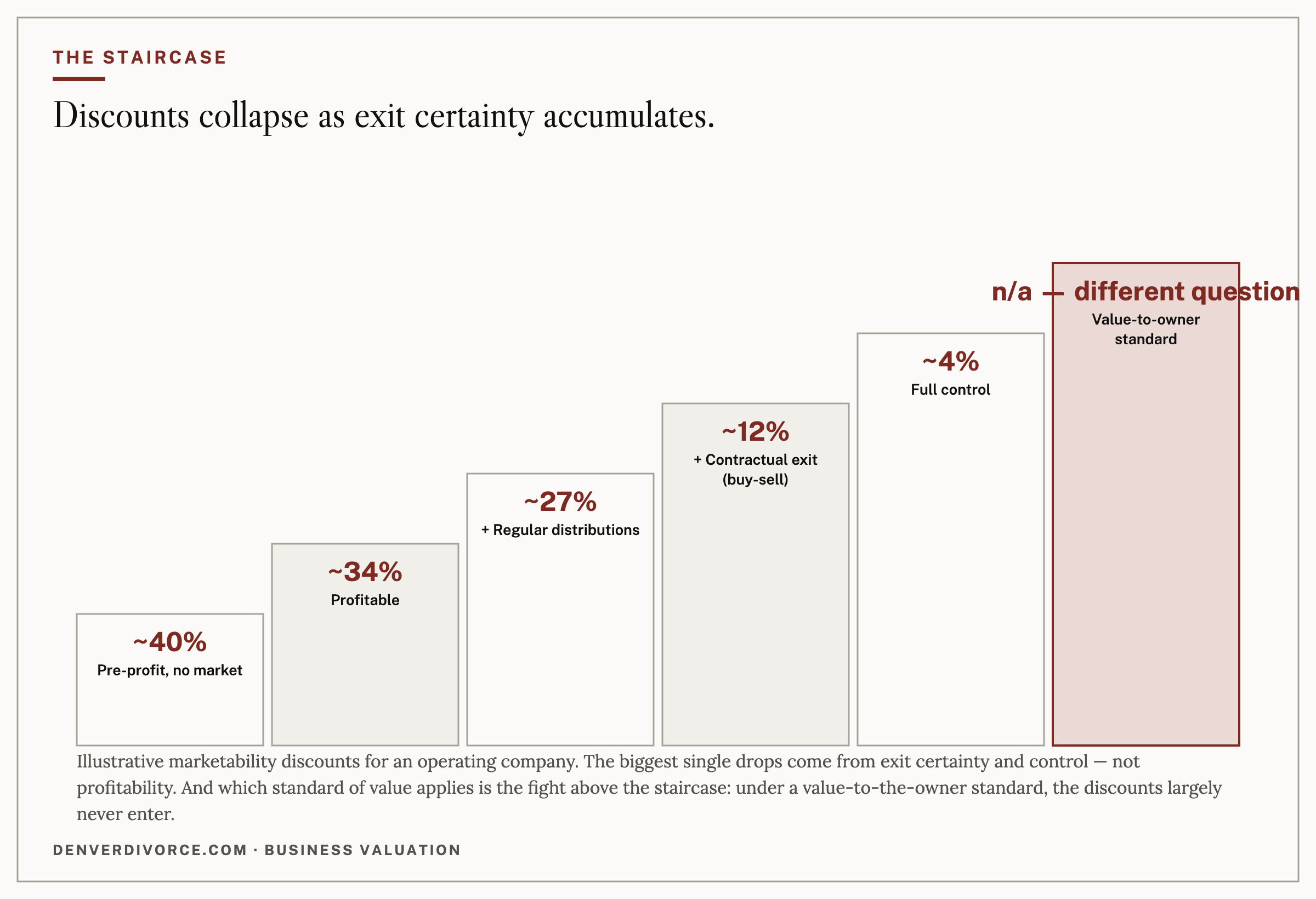
Working through the standard hypotheticals — the startup, the distributing family business, the professional practice, the owner-operator — a consistent pattern emerges: profitability helps a little; distributions help a little more; but exit certainty is what collapses a marketability discount. A buy-sell agreement that cashes an interest out at formula value within ninety days is marketability itself — the largest single step down. And full control brings the discount near its floor, because a controlling owner can choose to sell or liquidate at will.
That pattern is also a map of where the fights are won: not in dueling percentage surveys, but in the documents — the operating agreement, the buy-sell, the distribution history — that determine how close this interest sits to a real exit.
The practical point
When I take on a valuation dispute, the first strategic decision is the standard-of-value position, taken deliberately and early, with an expert who can defend it — because judges evaluating dueling experts reward the valuation whose logic they can follow and whose definition matches the case. If your expert and your lawyer haven't discussed which standard they are arguing and why, the percentage fight is being fought on unchosen ground.
Related on DenverDivorce.com: Business Valuation · Business Owner Divorce · Professional Practices
