
Divorces are decided at the end. They are shaped at the beginning. Between filing and the final decree — often a year or more in a complex case — somebody has to pay the mortgage, run the business, cover tuition, and fund the litigation itself. Temporary orders are how Colorado courts govern that interval, and for a business owner they are frequently where the trajectory of the whole case is set.
What a court can order, temporarily
Under C.R.S. § 14-10-108, either party may ask for temporary orders covering maintenance, child support, parenting time, payment of specific debts, use of property — including exclusive use of the home — and payment of attorney fees. The stated purpose, in the case law's words, is to maintain the status quo pending final disposition: keep the family functioning while the real questions get decided.
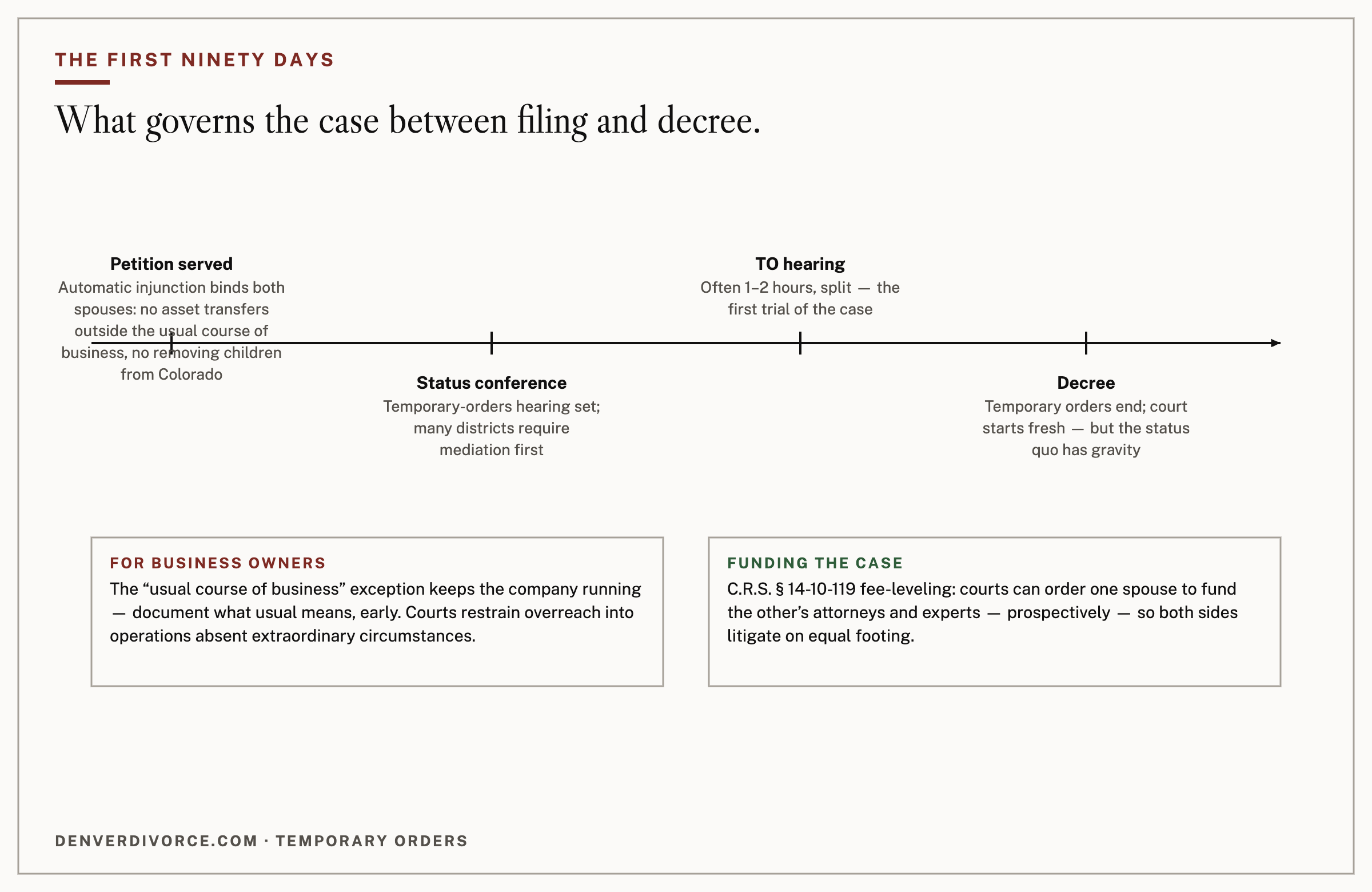
Two features matter before you ever reach a hearing. First, the moment a petition is served, an automatic injunction takes effect in every Colorado dissolution: neither spouse may transfer, conceal, or dispose of marital assets except in the usual course of business or for necessities, disturb the other's peace, or take the children out of state without consent or court order. Second, temporary financial relief can reach backward: Colorado courts have upheld temporary maintenance awarded retroactively, in some circumstances to dates before the petition was even filed.
The hearing is short. Prepare like it isn't.
Most judicial districts compress temporary-orders hearings brutally — commonly one to two hours, split between the parties, sometimes on offers of proof rather than full testimony, often with mandatory mediation first. The court will make consequential decisions about money and children on a fraction of the evidence a trial would hear.
That compression rewards preparation and punishes improvisation. The affidavit and financial disclosures do most of the persuading; the hearing confirms them. My approach is to treat temporary orders as the first trial of the case: triaged issues, clean exhibits, and numbers the court can adopt verbatim.
What business owners need to know
The "usual course of business" exception is your operating room. The automatic injunction restrains asset transfers — but expressly permits ordinary business operations, with an accounting for extraordinary expenditures. Documenting what "usual" looks like for your company, early, prevents every payroll run and equipment purchase from becoming a motion.
Courts protect businesses from overreach. Colorado authority restrains dragging business associates and operations into a divorce absent extraordinary circumstances — mere fear of dissipation is not enough. Ex parte orders that strangle a company's affairs have been struck down. If you receive one, move fast; if you're seeking one, come with evidence, not anxiety.
Fee-leveling is real. Under C.R.S. § 14-10-119, courts can order one spouse to fund the other's attorneys and experts — prospectively — so both sides can litigate on something like equal footing. Colorado appellate courts have upheld six-figure interim awards for fees and business-appraisal costs. If you are the moneyed spouse, budget for it; if you are not, ask for it early.
Temporary is not a preview of permanent. By statute, temporary orders do not prejudice either party's rights at permanent orders. Courts start fresh. But the practical status quo they create — who lives where, who pays what, how the children's week runs — has gravity. Choose your temporary positions with the end of the case in mind.
Related on DenverDivorce.com: Emergency Orders · Business Owner Divorce · Spousal Maintenance
