
An executive's balance sheet is mostly promises: a bonus not yet paid, awards not yet vested, deferred compensation not yet distributable. Divorce forces one question onto all of it — is this property to divide, or income to share? The answer is worth arguing about, because the same dollars cannot honestly be both.
The line that decides the case
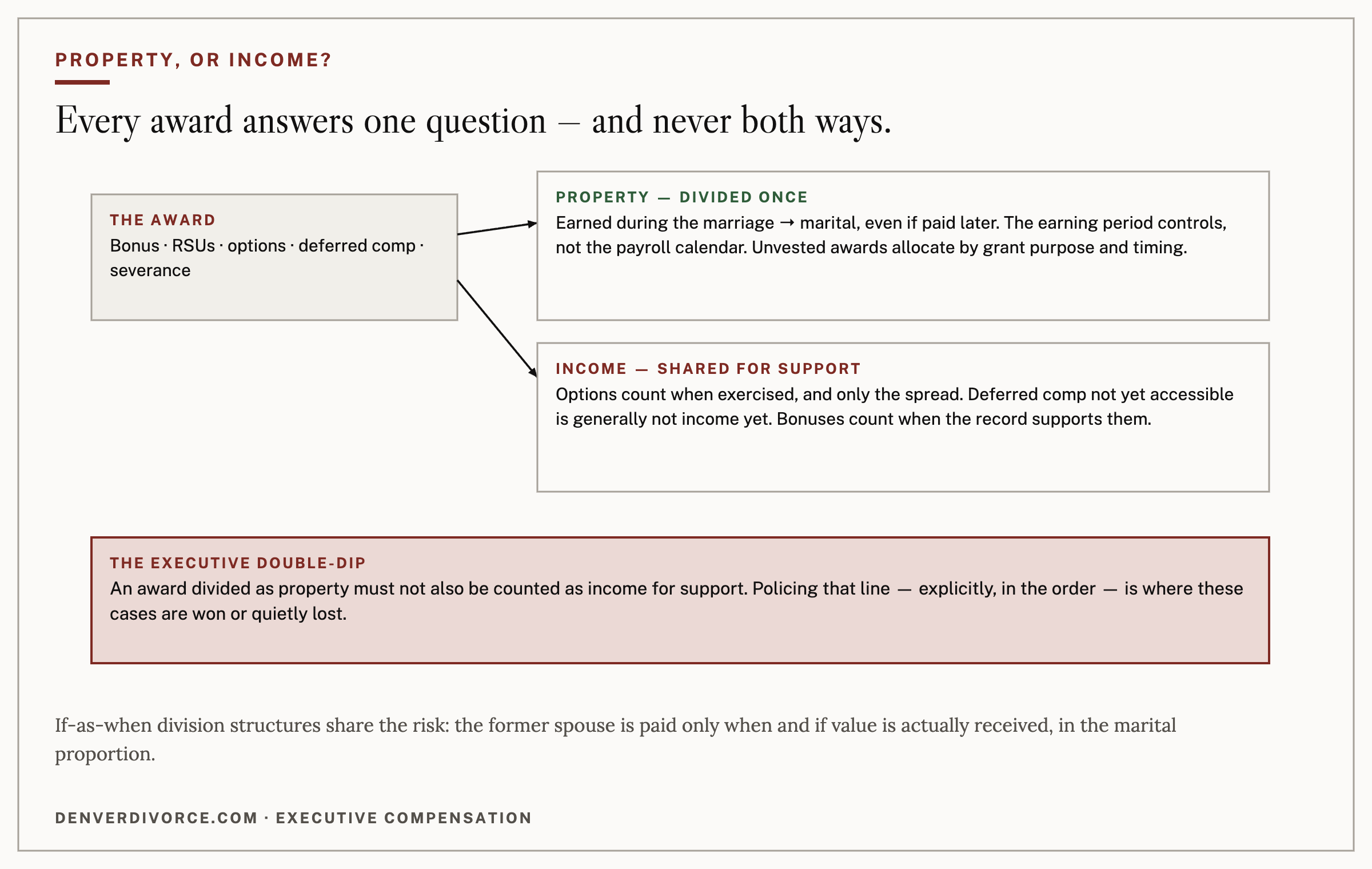
Compensation earned during the marriage is generally marital even if it pays out later — the earning period controls, not the payroll calendar. A bonus paid in March for last year's work belongs to last year. Awards granted purely for future services may remain separate until an enforceable right exists.
Most executive packages sit in between: part reward for the past, part retention for the future. Colorado allocates the marital share of unvested awards by their purpose and timing — which means the analysis starts with the grant documents, reading what each award was actually granted for. It is the step most divisions skip, and the step that changes outcomes.
The executive's double-dip
An award counted as property in the division should not also be counted as income for support. This is the executive's version of the valuation double-dip I've written about for business owners, and policing that line is a recurring, high-stakes issue: once the unvested RSUs have been divided as property, the income they later produce for support purposes needs careful, explicit treatment — in the order, not in assumptions.
The reverse error matters too. Stock options generally become income only when exercised, and only as to the spread — a distinction that changes support calculations by six figures for some executives.
Plans have rules; orders must respect them
Deferred-comp plans, LTIPs, and severance arrangements come with governing documents: distribution schedules, forfeiture and clawback provisions, transfer restrictions, and — for public-company insiders — trading-window realities. A settlement drafted without reading them produces orders the plan administrator cannot honor.
The structures that work inside the plans as written: if-as-when divisions that pay the former spouse only when and if value is actually received, in the marital proportion, so nobody buys out uncertainty at a certain price; tax gross-up terms so the economics survive the tax treatment; and security for the promises. In this corner of divorce law, the drafting is the outcome.
Will your company get dragged in?
Minimally, if it's handled well. Plan documents get produced; occasionally an administrator confirms mechanics. A properly drafted order works within the plan's rules — which is exactly what keeps your employer at arm's length from your case.
Related on DenverDivorce.com: Executive Compensation · Stock Options & RSUs · Spousal Maintenance
