In a long marriage, the pension is frequently worth more than the house. It is also the asset most often divided by a single sentence in the decree, "the parties shall divide the marital portion of Husband's pension equally," followed by months of silence while nobody drafts the order the plan will actually honor. By the time someone does, the valuation date is a matter of argument, the survivor benefit has been elected without the former spouse, and the plan's rejection letter explains that the decree asked for something the plan does not offer.
This article is about the two questions underneath that sentence: how a retirement benefit is valued, and how it is actually divided. Colorado has its own case law on the first question and its own statute on the second, and both are different from what a national explainer will tell you.
Why the Decree Alone Divides Nothing
A retirement plan is a contract between the employee and the plan, administered under federal or state law that the divorce court cannot override. The decree binds the spouses. It does not bind the plan. For an employer plan governed by ERISA, which includes most private 401(k)s and pensions, the plan may pay anyone other than the participant only under a qualified domestic relations order, the QDRO, which the plan administrator, not the judge, decides is qualified under I.R.C. § 414(p) and ERISA § 206(d)(3). For a Colorado public plan such as PERA or FPPA, the plan may divide a benefit only on the parties' written agreement under C.R.S. § 14-10-113(6), on the plan's own form, within the statute's deadlines. For military retired pay, the Defense Finance and Accounting Service pays a former spouse directly only when the order satisfies 10 U.S.C. § 1408. An IRA needs none of this; it moves by a trustee-to-trustee transfer under I.R.C. § 408(d)(6), and the only way to get it wrong is to take a distribution instead.
So the decree is the first document, not the last. The second document, the order the plan accepts, is where the money is actually won or lost.
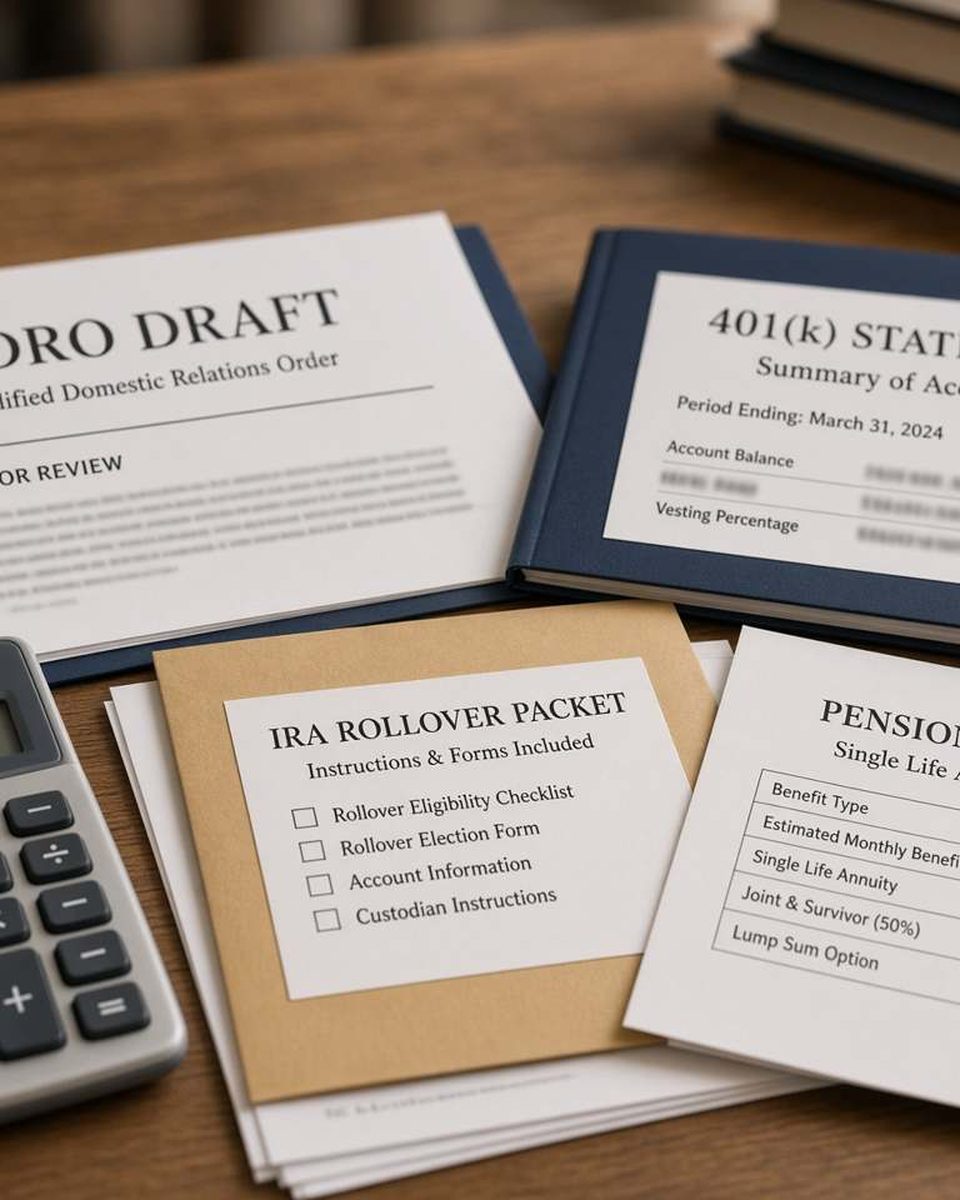
The Three Ways a Colorado Court Divides a Pension
Everything in Colorado pension law runs through In re Marriage of Hunt, 909 P.2d 525 (Colo. 1995). The Colorado Supreme Court described three methods and left the choice among them to the trial court's discretion.
Net present value, or immediate offset. An actuary values the marital share of the pension today. The employee keeps the pension; the other spouse receives other property of equal value. The divorce is over on the day of the decree. Hunt favored this method for small pensions and where finality matters, and the court of appeals confirmed in In re Marriage of Riley-Cunningham, 7 P.3d 992 (Colo. App. 1999) that it can be used even when the pension is not yet in pay status.
Deferred distribution. The court fixes the former spouse's percentage now and the former spouse is paid that percentage of each benefit check when the employee retires. Nothing changes hands at the decree. This is the method that produces the QDRO or the PERA order, and it is the default for a pension too large to offset.
Reserved jurisdiction. The court keeps the case open and decides the share later, when the benefit vests or matures. It is rarely used because it leaves both parties uncertain for years, but it exists for the pension that may never pay at all.
The methods are not interchangeable, because Hunt attached a rule to the choice. If distribution is delayed, by deferred distribution or reserved jurisdiction, the former spouse shares in everything the pension becomes, including raises, promotions and additional service earned after the divorce. The court called this the "marital foundation" theory: the post-divorce career is built on the marital years, and the economic partnership in the pension continues as long as the former spouse is bearing the risk of waiting. Under net present value, by contrast, the pension is priced at the salary on the decree date and the employee keeps every later enhancement. The same pension can therefore be worth very different amounts to the former spouse depending on which method the court selects, which is why the method, not the percentage, is where the real negotiation happens.
The Time Rule, Worked Out
Under deferred distribution the marital share is set by the time rule, also called the coverture fraction. The numerator is the months of pension service during the marriage. The denominator is the total months of service at retirement. The fraction is multiplied by the benefit actually paid, and the former spouse receives half of the result.
A teacher married for 18 of the 30 years she teaches has a pension that is 18/30, or 60 percent, marital; her former spouse receives 30 percent of each check. If she works 35 years instead, the fraction becomes 18/35 and the former spouse's share drops to about 26 percent, but of a larger benefit. That is the trade the time rule makes: the denominator grows with the career, and so does the check.
Three Colorado decisions mark the edges of the formula. In re Marriage of Kelm, 912 P.2d 545 (Colo. 1996), held that the denominator must be the employee's actual total service, not an assumed number of years, and that a lump-sum death benefit is divided by the same fraction, not awarded entirely to the former spouse. In re Marriage of Lockwood, 971 P.2d 264 (Colo. App. 1998), held that once deferred distribution is chosen, the trial court may not adjust the fraction for equitable reasons; the numerator ends on the real date of dissolution, and fairness is exercised in choosing the method, not in rewriting the arithmetic. And the companion case decided with Hunt held that a trial court abused its discretion by trimming the former spouse's share from 50 to 40 percent of the marital portion because she had received more of the other property; the formula is applied in its pure form or not at all.
The formula also has a failure mode that In re Marriage of James, 950 P.2d 624 (Colo. App. 1997), corrected. In a four-year marriage to a teacher with 30 years of PERA service, the wife's expert valued the marital share by subtracting the pension's value on the wedding day from its value at the decree, producing roughly $190,000. The court of appeals called the subtraction method "terribly misleading," because nearly all of the growth during those four years came from 28 years of premarital service compounding, and reversed. The marital share is the coverture fraction applied to the whole benefit, whether the benefit is valued today or paid later. James also settled a related point: anticipated Social Security benefits cannot be divided or used as an offset, because federal law preempts them, so a PERA member's lack of Social Security does not shrink the marital share of the PERA benefit.
How an Actuary Prices a Pension
When the net present value method is chosen, someone has to turn a promise of $4,000 a month starting at 65 into a number today. The inputs are few, and every one of them moves the result.
The accrued benefit. The monthly amount the plan would pay at normal retirement age based on service and salary through the valuation date. In Colorado the valuation date is the date of the decree or the property hearing, under C.R.S. § 14-10-113(5), and under In re Marriage of Nordahl the benefit is assumed to be taken at normal retirement age with a full benefit unless the evidence shows otherwise.
Retirement age. A benefit that starts at 55 is worth far more than the same monthly amount starting at 65, because it pays for ten more years. Many public plans, PERA and FPPA among them, allow full retirement well before 65, and an expert who assumes 65 for a firefighter eligible at 55 has undervalued the pension by a third or more.
The discount rate. Future payments are reduced to present value at an interest rate. Practitioners' surveys show rates in use from about 2.5 percent to 9 percent; a 5 percent rate is common among plans that actually pay lump sums. The direction is simple: a low rate makes the pension worth more today, a high rate makes it worth less. Two experts using 4 percent and 7 percent on the same pension will be tens of thousands of dollars apart on a mid-sized benefit, and both will be able to cite authority.
Mortality. How long the payments are expected to continue. Actuarial tables built for plan funding, such as the RP-2014 series, assume longer lives than general population tables, which raises the value. The choice of table is a legitimate expert judgment and a predictable source of disagreement.
Cost-of-living adjustments and subsidies. A pension with an annual COLA, which PERA and military retired pay have, is worth substantially more than a flat one, and an early-retirement subsidy that lets the employee retire at 55 without an actuarial reduction is itself a valuable benefit. A valuation that ignores either undervalues the asset.
Tax. Every dollar of a pension is taxed as ordinary income when paid. A present value computed before tax and then offset against the equity in a house, which is largely tax-free on sale, trades an after-tax asset for a pre-tax one at face value. The value should be tax-effected, or the offsetting asset should be, before anyone signs.
Because of all this, a pension valuation is an argument, not a measurement. The two sides' experts in James were $130,000 apart on the same PERA account. The practical lesson is that the party who wants the offset must be able to defend each assumption, and the party who prefers deferred distribution usually does not need an expert at all, because the time rule prices nothing; it waits.
Shared Payment or Separate Interest: The Choice That Decides Who Gets Paid When Someone Dies
An ERISA pension can be divided by QDRO in one of two ways, and the Department of Labor's guidance is explicit that federal law requires neither. The difference matters most at death.
Under a shared-payment order, the former spouse receives a stated share of each payment the participant receives, and only then. If the participant has not retired, the former spouse waits. If the participant dies, the payments stop, and the former spouse's share stops with them unless the order also named the former spouse as the surviving spouse for the qualified joint and survivor annuity. If the former spouse dies first, the share reverts to the participant.
Under a separate-interest order, the former spouse's share is carved out as a benefit of its own, actuarially adjusted to the former spouse's life expectancy. The former spouse can usually start it at the participant's earliest retirement age whether or not the participant has retired, can choose the form of payment, and keeps it for life regardless of what happens to the participant afterward. The participant's death after the former spouse's benefit begins does not end it. The risk that remains is death before benefits begin, which is why a separate-interest QDRO should also award the former spouse the qualified pre-retirement survivor annuity for the marital share.
The choice has to be made when the order is drafted, because many plans will not sever a benefit after it has entered pay status, and no plan will add a survivor annuity after the participant has retired and elected a single-life benefit. Under In re Marriage of Payne, 897 P.2d 888 (Colo. App. 1995), a Colorado court may order the participant to elect survivor coverage for the former spouse and allocate the cost. That order has to be in the decree; it cannot be added later.
Government plans do not offer the choice. PERA, FPPA, FERS and military retired pay are shared-payment systems in substance: the former spouse is paid when and because the member is paid, and the only protection against the member's death is a survivor or cobeneficiary election made under that plan's rules, which reduces the monthly benefit. The Colorado Supreme Court held in In re Marriage of Mack, 2022 CO 17, that a PERA retiree who has named a former spouse as cobeneficiary cannot remove that designation without a court order, which is as close as a public plan comes to a separate interest.
What the Order Has to Say
A domestic relations order becomes a QDRO only if it contains what the statute requires and nothing the statute forbids. It must name the participant and each alternate payee with mailing addresses, name each plan by its legal name, state the amount or percentage of the benefit assigned or a method for determining it, and state the number of payments or period covered. It may not require the plan to provide a form of benefit it does not offer, to pay more than the actuarial value of what the participant has, to pay a benefit already assigned to an earlier alternate payee, or to pay before the participant's earliest retirement age unless the plan permits it.
Within those limits, the drafting decisions that change the result are these.
For a defined benefit pension: whether the share is computed by the time rule or fixed as a percentage; whether the former spouse shares in COLAs, early-retirement subsidies and post-decree accruals (under a shared-payment order the former spouse automatically receives a share of any subsidy or increase unless the order says otherwise; under a separate-interest order the order must say so affirmatively); whether the former spouse is the surviving spouse for the joint and survivor annuity and the pre-retirement survivor annuity; and whether the former spouse may start benefits before the participant retires.
For a 401(k) or other defined contribution plan: the valuation date, almost always the decree date; whether the assigned amount is adjusted for gains and losses between that date and the date the plan segregates the account; how an outstanding plan loan is treated; and that the alternate payee's share is taken pro rata from pre-tax and Roth sources, because the plan will not let the order pick one.
For timing: once the plan receives the order it must separately account for amounts that would be payable to the alternate payee while it decides whether the order is qualified, for up to 18 months from the first date a payment would be due. If the order is rejected and not fixed within that window, the segregated amounts are released to the participant. A rejected order is therefore a clock, not a formality.
For tax: a distribution to a former spouse under a QDRO is taxed to the former spouse, not the participant, under I.R.C. § 402(e)(1)(A); the former spouse may roll it to an IRA under § 402(c); and a cash distribution to a former spouse under a QDRO is exempt from the 10 percent early-withdrawal penalty under § 72(t)(2)(C), an exemption that is lost the moment the money is rolled into an IRA. A former spouse under 59½ who needs cash from the settlement should take it from the plan under the QDRO, before the rollover, not after.
Colorado Public Plans: PERA and FPPA Are a Statute, Not a QDRO
Nothing above applies to a Colorado public employee's pension. PERA, which covers state employees, teachers, and many local government workers, and FPPA, which covers police and firefighters, are governmental plans exempt from ERISA. They are divided under C.R.S. § 14-10-113(6), and the statute is built differently from federal law in one respect that catches people every year: the court cannot divide the benefit at all. Subsection (6)(f) provides that a court "shall have no jurisdiction to enter an order dividing a public employee retirement benefit" except on the parties' written agreement. If the member refuses to agree, the former spouse's remedy is an offset against other property, priced by an actuary, and nothing else.
When there is an agreement, the statute dictates its form. The agreement must identify the plan and the parties and choose exactly one division method for a defined benefit: a fixed dollar amount, a fixed percentage, a time-rule formula, or a decree-date formula. It must be submitted to the plan within 90 days after entry of the decree and permanent orders, must reach the plan at least 30 days before the first payment, and cannot start the alternate payee's payments before the member retires or reaches 65, whichever comes first. The alternate payee's rights end at the alternate payee's death; nothing passes to an estate. The court may not modify an approved agreement without both parties' written consent.
Both plans require their own forms without alteration. PERA uses a Domestic Relations Order for a PERA Benefit Plan and a separate Agreement for Domestic Relations Order, and will review a draft before the court signs it; the certified order and the decree must reach PERA within 90 days after entry. FPPA requires its Agreement for Division of Pension Benefits and Order, with notarized signatures, filed within 90 days. Under an FPPA pre-retirement order the alternate payee's portion is severed and paid for the alternate payee's lifetime once the member retires; under a post-retirement order it ends at the member's death. If an actively employed FPPA member dies before retirement, the statutory survivor benefit goes to the current spouse and dependent children, not the former spouse.
Two valuation points are specific to these plans. Kelm held that PERA is a hybrid plan whose present value cannot be measured by the member's contributions; it requires actuarial assumptions like any pension, which matters whenever a PERA member proposes to "just refund" the contribution balance as the marital value. And PERA's defined benefit carries an annual increase, so any present value that omits the COLA is low.
Military and Federal Civilian Retirement
Military retired pay has been divisible marital property in Colorado since In re Marriage of Gallo, 752 P.2d 47 (Colo. 1988), and the time rule from Hunt was itself a military case. Three federal rules now sit on top of that.
The frozen benefit rule. For a decree entered on or after December 23, 2016, while the member is still serving, 10 U.S.C. § 1408 limits the divisible retired pay to what the member would have received had the member retired on the decree date, at the rank and years of service held that day, plus later cost-of-living adjustments. The marital-foundation rule from Hunt is preempted for these members: post-decree promotions and service belong to the member alone. The order must state the member's high-3 base pay, pay grade and creditable service as of the decree, and DFAS rejects orders that leave those figures out. For a member already retired at the decree, the frozen benefit rule does not apply and Hunt operates as written.
Direct payment. DFAS pays the former spouse directly only if the marriage overlapped at least ten years of creditable service, the "10/10 rule"; otherwise the member pays the former spouse personally, and the order should say so. Direct pay is capped at 50 percent of disposable retired pay.
The Survivor Benefit Plan. Retired pay stops at the member's death. Former-spouse SBP coverage protects the share, but the election or deemed election must be filed with DFAS within one year of the order requiring it, and a member who retired without electing SBP cannot add it later. Under Payne the court may order the election and allocate the premium.
Disability pay is the trap. A retiree who waives retired pay to receive tax-free VA disability compensation reduces the former spouse's share dollar for dollar, and after Howell v. Howell, 581 U.S. 214 (2017), no state court may order the retiree to indemnify the former spouse for the reduction. The Colorado Court of Appeals applied Howell in In re Marriage of Tozer, 2017 COA 151, overruling the earlier Colorado cases that had permitted indemnification, and later divisions have held that Howell reaches pre-2017 agreements as well. The only remaining tools are the ones the court has at the decree: a disproportionate award of other property, or maintenance, which may account for disability income even though property division may not.
Federal civilian employees under FERS and CSRS are divided by a Court Order Acceptable for Processing submitted to the Office of Personnel Management; the former spouse is paid only when the employee is paid, and a former-spouse survivor annuity must be ordered expressly. The Thrift Savings Plan, for both federal civilians and service members, is a defined contribution account and divides like a 401(k), by a retirement benefits court order under the TSP's own rules.
The Mistakes That Cost the Most
A short list, in the order they tend to happen. Dividing the pension "equally" in the decree without choosing a method, so the time rule and the present value are both arguable later. Choosing an offset without tax-effecting the pension or the asset traded for it. Leaving survivor coverage unaddressed until after the participant has retired and elected a single-life benefit. Letting a public-plan agreement miss its 90-day window, after which the plan will not accept it and the court cannot order it. Omitting the frozen-benefit figures from a military order. Rolling a QDRO distribution into an IRA before taking the cash the former spouse needed, and paying a penalty the Code had waived. And treating the decree as the finish line, when the plan has not yet seen a single page of it.
Talk to a Denver Divorce Attorney About Your Retirement Division
Aaron Herzberg is a divorce and custody trial lawyer in Greenwood Village, Colorado, serving Denver and the Front Range, with more than thirty years of trial experience and a Georgetown LL.M. in Taxation. In a case with a pension, the work is deciding the method before the decree, pricing the benefit after tax, and drafting the order the plan will accept while the leverage still exists. A first meeting is a paid consultation, not a free call and not a sales pitch.
Read the full guides on DenverDivorce.com: QDROs & Retirement Plans, Military Divorce in Colorado and Divorce & Taxes.
Educational information only, not legal advice. Reading this article does not create an attorney-client relationship.
