
Colorado's child support statute, C.R.S. § 14-10-115, has been rebuilt over the last two legislative cycles — Senate Bill 23-173 and House Bill 25-1159, both following the Colorado Child Support Commission's recommendations. The changes are now in effect, and several of them matter a great deal to high-income parents.
The overnight cliff is gone
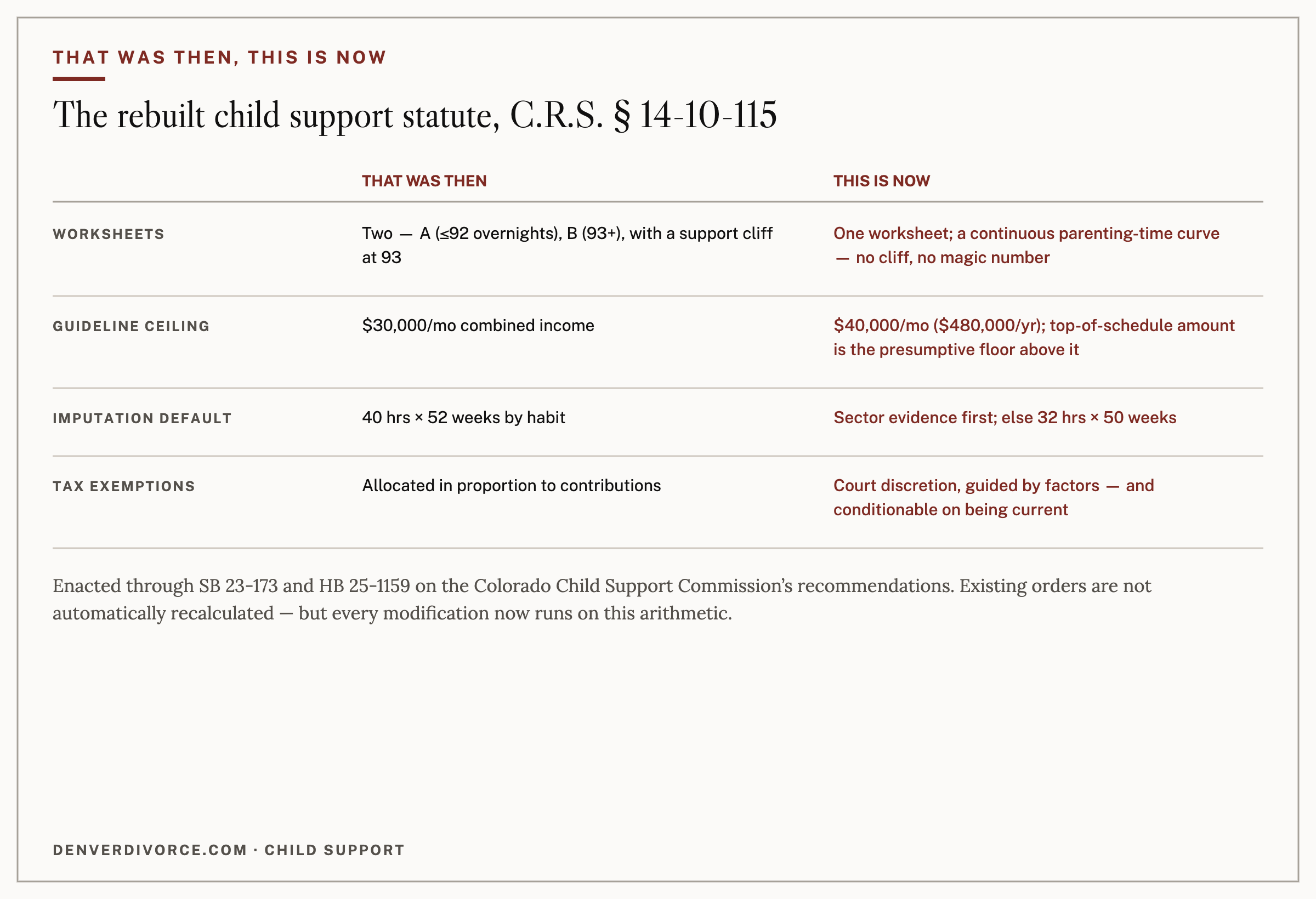
The old system ran two worksheets: Worksheet A up to 92 overnights, Worksheet B from 93 — with a support cliff at the boundary that made the 93rd overnight worth real money and produced years of schedule-engineering litigation.
The new system uses one worksheet and a continuous curve. Parenting-time credit phases in smoothly with overnights: the credit lags the parenting-time percentage at lower levels, accelerates past roughly 27%, and catches up at 50/50. No cliff, no magic number — and one less thing to fight about for the wrong reasons. With multiple children on different schedules, support now runs on a single methodology using the children's average overnights.
The guideline ceiling rose to $40,000 a month
The guidelines previously topped out at $30,000 of combined monthly income; the schedule now extends to $40,000 per month — $480,000 a year. For high earners, that moves more territory from discretionary argument into the guideline table. Above the ceiling, the framework is unchanged: the amount at the top of the schedule is the presumptive floor, and anything above it rests on the court's discretion and the children's reasonable needs — which, for the families I represent, is where the actual case lives.
Imputation got more disciplined
When a parent is voluntarily unemployed or underemployed, courts determine potential income. The statute now points to evidence about the hours actually available in that parent's sector, and — absent reliable data — sets the default at a reasonable rate of pay for a 32-hour week, 50 weeks a year, replacing the old 40/52 habit. Imputation fights now turn more on labor-market evidence and less on assumption.
Dependency exemptions became discretionary
Courts previously allocated the right to claim children for tax purposes in proportion to each parent's contribution. The court now has discretion, guided by factors: each party's financial resources, whether a claimed exemption actually produces a tax benefit, and the interaction with other credits. Courts can also condition the right to claim a child on being current on support. For parents whose returns are complicated — phase-outs, credits, business income — this is worth modeling, not assuming.
The practical point
Support orders entered under the old statute are not automatically recalculated — but the new law changes the arithmetic of any modification, and for some parents the new curve and ceiling move the number materially in one direction or the other. Before filing (or resisting) a modification, run the numbers under the current statute. The answer may surprise you either way.
Related on DenverDivorce.com: Child Support · Modifications · Parenting Time
