
When parents cannot agree on parenting arrangements, Colorado courts frequently appoint a neutral to investigate and recommend. There are two such neutrals, and the difference between them is not a matter of degree.
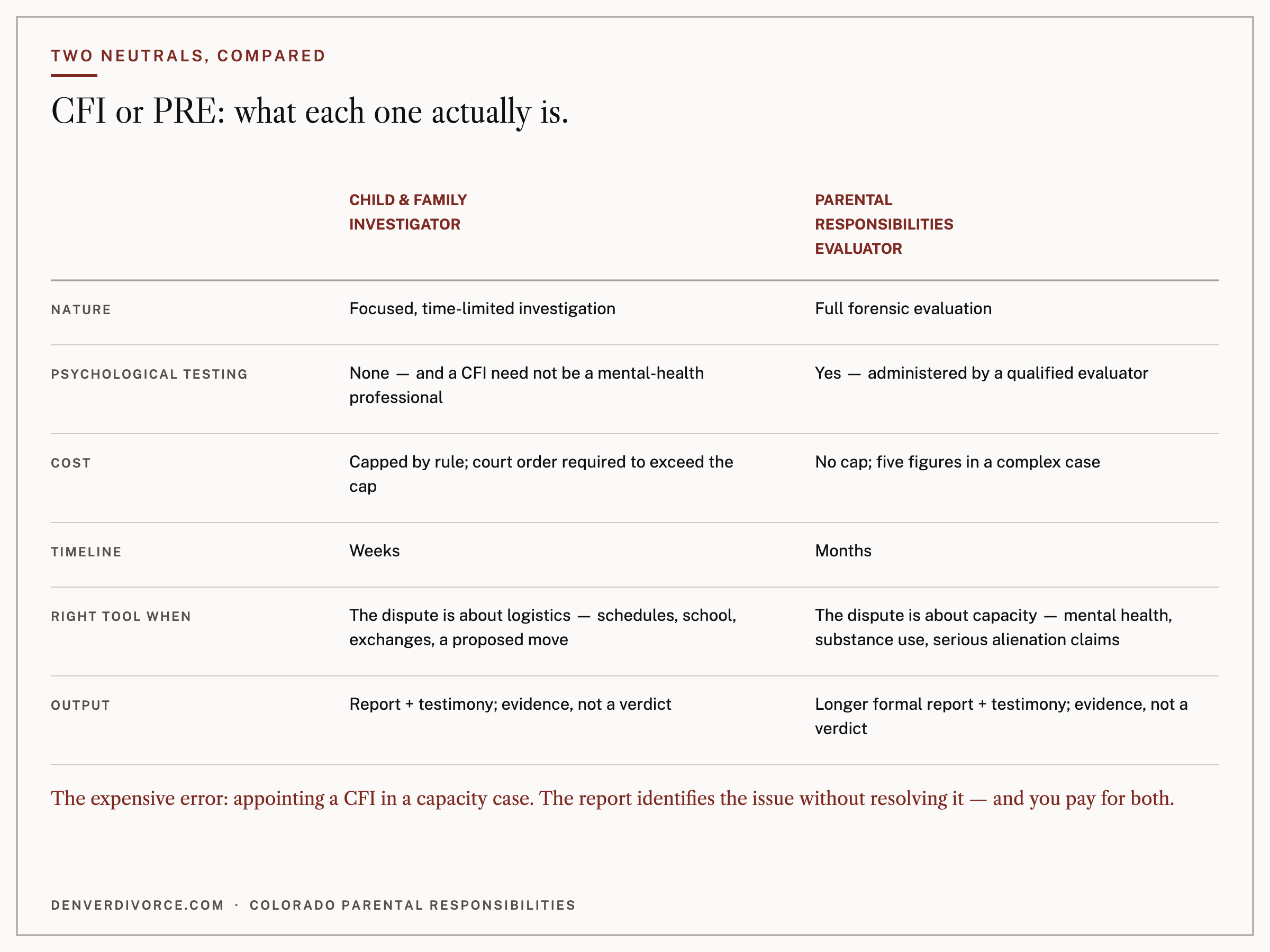
A Child and Family Investigator — a CFI — conducts a focused, time-limited investigation and reports to the court. A Parental Responsibilities Evaluator — a PRE — conducts a full evaluation, typically including psychological testing, and produces a substantially longer and more expensive report.
Choosing between them is one of the earliest strategic decisions in a contested parenting case, and it is often made by default rather than by analysis.
What a CFI does
A CFI is appointed to investigate and make recommendations on specific issues the court identifies in the appointment order. The investigation is proportionate: interviews with each parent, interviews or observations involving the children, contact with collateral sources such as teachers, therapists, and family members, and a review of records. The output is a written report and, if the case goes to hearing, testimony.
The defining features of a CFI appointment are scope and cost. The appointment order limits what the CFI is asked to look at, and Colorado caps CFI fees at a level the court can only exceed by specific order. That cap is what makes a CFI accessible — and also what makes the appointment unsuitable for a case that genuinely requires more.
A CFI is not required to be a mental health professional, and a CFI does not administer psychological testing.
What a PRE does
A PRE conducts a full parental responsibilities evaluation. In practice that means everything a CFI does, plus psychological instruments, a substantially deeper review of history, and a longer, more formal report.
There is no equivalent fee cap. A PRE evaluation in a complex case runs into five figures, and the timeline runs in months rather than weeks.
That expense buys something specific: an evaluation qualified to speak to questions a CFI cannot. Where a parent's mental health, substance use, or personality functioning is genuinely at issue — not merely alleged — a CFI's report will note the concern and stop. A PRE's evaluation can address it.
How the choice actually gets made
The honest framing is a question about the dispute, not about the parents.
If the disagreement is about logistics — schedules, exchanges, school enrollment, how holidays divide, whether a proposed move works — a CFI is almost always the proportionate tool. The investigation is faster, the cost is bounded, and the recommendations land while the dispute is still current.
If the disagreement is about capacity — whether a parent can safely and consistently care for the children, where mental health or substance use is squarely in play, where allegations of alienation are serious rather than rhetorical — a CFI report will very likely tell you that a fuller evaluation is needed. You will then pay for both.
The most common and most expensive error is appointing a CFI in a case that needed a PRE, receiving a report that identifies the issue without resolving it, and starting over six months later.
What to watch for regardless of which is appointed
The appointment order is the investigation. The neutral investigates what the order tells them to investigate. Time spent getting the scope right at the front of the case is worth more than anything that happens afterward.
Collateral sources are where cases turn. Teachers, pediatricians, therapists, coaches. A parent who cannot name a single neutral third party familiar with their day-to-day involvement with the children has a problem that no advocacy will solve.
The report is evidence, not a verdict. The recommendations of a CFI or PRE are influential and frequently adopted, but they are subject to cross-examination. A methodologically weak report can be challenged. A parent who receives an unfavorable report has options; the first of them is not panic.
Cost allocation is negotiable. Who pays, and in what proportion, is addressed in the appointment and is a legitimate subject of argument.
The practical point
Ask, early: what question does this case actually turn on? If it is a scheduling question, a CFI answers it. If it is a capacity question, a CFI will not, and the money spent finding that out is money spent twice.
Related on DenverDivorce.com: Parental Responsibilities · Parenting Time
